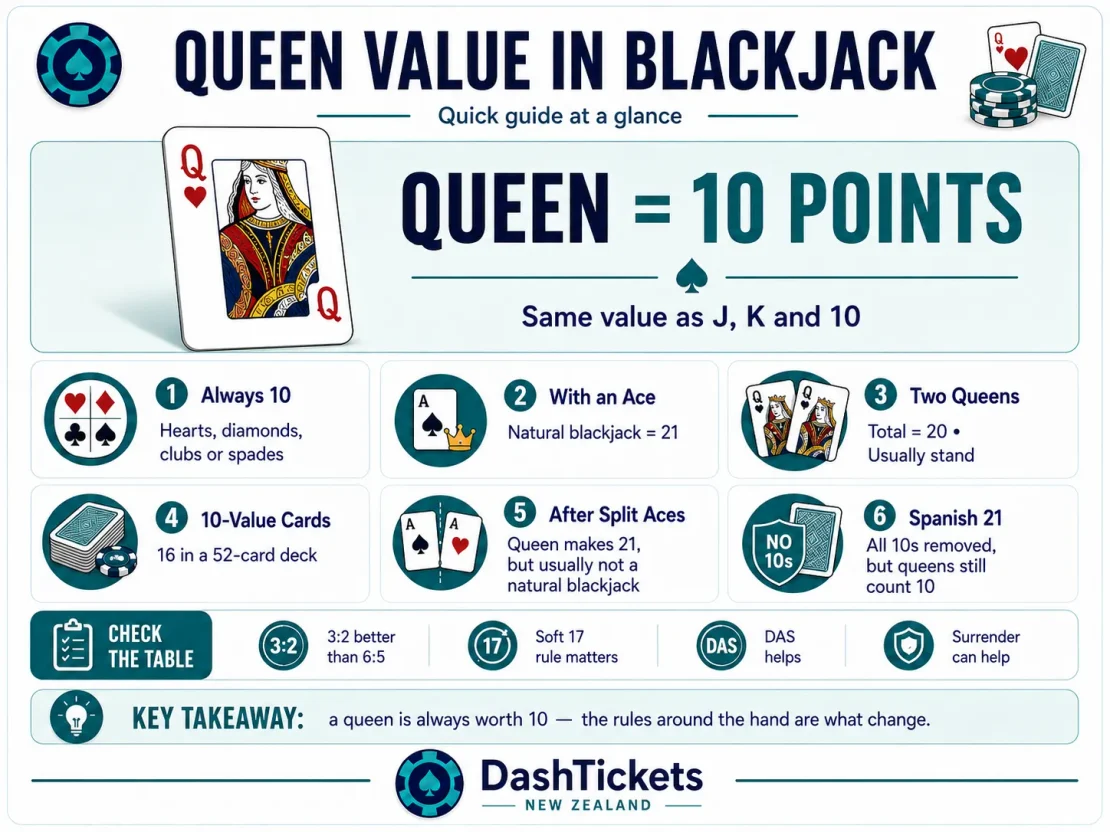
In blackjack, a queen has a value of 10 points. The queen has the same value as the jack, the king and the 10, no matter which suit it belongs to. It works like that at all online casinos’ online blackjack, live dealer blackjack and brick-and-mortar casino tables. While the appearance of the card might differ, the value of the number added to the hand always stays the same.
The majority of questions arise from the situation when the queen appears with the ace, totals 21 or is dealt as a part of the pair. It is not the value of the queen itself that changes; the whole hand changes the meaning. The payouts on the table and the possible moves become different, which is why the one-word answer does not provide the full picture.
How Much Is a Queen in Blackjack?
Each queen in the basic blackjack hand is equal to 10 points. No matter if you have a queen of hearts, diamonds, clubs or spades, you have exactly the same value in your hand. The same value has the jack and the king. Along with the four numbered 10s, it makes 16 cards of the value 10 in a 52-card deck. You can find more information about other cards in the article on values of the cards in blackjack.
Therefore, counting a queen in a hand is quite easy. The queen with 6 makes 16, the queen with 9 makes 19, and two queens make 20. If you have already got 12 points and receive the queen in your hand, you bust (your score equals 22). The value of the queen itself does not change in any case.
Blackjack with the Deal of a Queen
The combination of a queen and an ace is a natural blackjack when it comes at the start of the game as the first two cards. With a total value of 10, the queen is complemented by the ace worth 11, reaching the score of 21. In addition, an ace together with a jack, king or ten is also the same hand. In accordance with the usual rules, a natural blackjack hand is better than the hand 21 with three or more cards.
The total of 21 with a queen, 5 and 6 is also possible; however, it is not considered to be a natural blackjack because it includes three cards. This is important as there are different payoffs for a natural blackjack (3:2 or 6:5 depending on the rules) and for an ordinary winning hand of 21, which pays even money. If both the player and the dealer get a natural blackjack, there will be a tie and the bet will be returned. It is still necessary to find out the exact rules for the payoff before the game.
It is also necessary to remember that if a queen appears after splitting aces, it leads to getting 21. However, it is not considered to be a natural blackjack on most tables and gets the same payoff as an ordinary winning hand.
Working with a Queen and an Ace
Unlike all other common cards in a game of blackjack, an ace is a unique card as it may count differently depending on what number will help get the most out of the hand without exceeding the limit of 21. If a queen and an ace appear first in the hand, then the ace will count 11 and the whole hand will total 21. There is nothing to do as it is impossible to improve the hand anyway.
An ace, a 6 and a queen together equal 27 if we count an ace as 11, thus we will have to reduce the value of an ace to 1 making the total value of the hand 17. In this case, the combination of an ace and 6 was soft 17, however, as soon as the queen comes in, the hand becomes hard 17 as an ace cannot be counted as 11 anymore. Nevertheless, a queen still accounts for 10 points as before.
The simplest way to evaluate a hand is to count each jack, queen and king as 10 first and then find out whether an ace should count as 1 or 11. This method helps avoid mistakes and counting of a queen instead of an ace. In addition, it helps speed up calculations of long hands greatly.
Playing with a Queen in the Hand
Just as with any other card, getting a queen does not necessarily mean that the player needs to decide to either hit or stand. What matters here are the totals of the cards in the hand and the dealer’s card. Thus, the totals of the hand consisting of a queen and a 2 and the hand consisting of a queen and an 8 differ greatly; the first equals 12, while the second equals 18. Our blackjack strategy guide describes how to play the former and latter differently.
Getting two queens gives the player a total of 20, so basic strategy usually recommends standing. Splitting is changing one powerful hand for two weaker hands, each of which will need one additional card. It cannot be predicted for sure whether they will get another 20 despite the fact that there are plenty of 10-valued cards in the deck. While casinos allow splitting the queens, this option is not necessarily the best one.
Does the Queen’s Suit Matter?
The queen suit plays no role for calculating the score of a queen in a standard blackjack game. No matter what suit the queen has (be it clubs, diamonds, hearts or spades), it still provides 10 points to the player’s total. The dealer treats red and black queens as equally valuable for the main total calculation, and the suit makes no difference for hit, stand, double down or splitting options.
There may be some additional bets related to specific suits of queens depending on what optional side bet is offered by the table. Some casinos provide the possibility to place the bet on getting a specific queen and provide the corresponding payout for this combination; however, such bet does not influence the outcome of the main blackjack hand. If a queen makes a winning side-bet combination, it still counts as 10 in the main hand.
The additional bets require specific cards and payoffs that may vary from one casino table to another. One table might have one combination, while the other table does not have it despite being played in accordance with the standard rules of the game. The conditions of each side bet need to be checked in the table where the game is played; the queen suit cannot influence the main hand in any way.
Value of Queen in Different Blackjack Variations
Queen retains its value of 10 points in classic, European and Atlantic City variations of the game. The same applies to many variations featuring a live dealer or a random number generator. In the case of these games, the differences relate to such aspects as the number of decks, dealer’s actions, restrictions on doubling, surrender rules or payouts for a natural hand. These features can influence a player’s strategy but cannot change the way the queen is counted.
Spanish 21 is one of the examples of blackjack variants as well as an example of a change in the deck’s composition. All numbered 10s are removed from the deck but jacks, queens and kings are included into the deck and retain their value of 10 points. Changes in the deck’s composition and several other rules create opportunities for forming winning combinations in the game.
There are a number of modern blackjack variants that use multipliers and bonuses based on certain cards. Features of this kind usually impact the payout and not the value of a card itself. The queen will retain its value of 10 points in all cases unless otherwise indicated in the rules of the variation in question. Checking the paytable can help to avoid confusion.
What to Check Before Playing
At almost any regular blackjack table, a queen will be worth 10. However, this is not enough for all tables to be treated equally. It should be checked whether the natural pays 3:2 or 6:5, whether the dealer stands or hits on soft 17 and whether doubling after a split is possible. The number of decks and whether surrender is allowed can also have an effect. All these parameters are important not for the evaluation of the queen but for the strategy and cost of playing.
To compare the games available, players can use our list of online blackjack casinos in New Zealand. This page includes information about different versions of blackjack and the parameters that should be checked before choosing the table. There are also other guides and rule explanations on the site of DashTickets. Blackjack is a form of gambling, so it should only be played by people aged 18 or over who can afford to lose their money.
Sophia Novakivska has already been spending 12 years on everything related to gambling writing. Slot and casino reviews, comparisons, top options for different audiences, news, how-tos and gambling history - she knows the area and proved it with her publications on Better Collective, AskGamblers and Gambling.com. For four years, Sophia is into NZ iGaming niche where she analyzes the online casino bonuses, live games, new slot releases, and sport news. Sophia’s credentials: GLI University’s iGaming testing & compliance course (2020) and UKGC-approved Responsible Gambling certification (2022).
Syndicate casino offers a huge selection of gambling entertainment of all popular genres: from the familiar slots and roulette to poker and live dealer games. Syndicate offers each of them regular bonuses, an elaborate loyalty program, and round-the-clock support. Syndicate Registration Registration for new players is made as simple as possible. It takes just two […]
In 2026, the event industry in New Zealand has definitely stepped beyond the realm of sheer relief about returning to normality and started thinking seriously about creating memorable experiences. Today, the organizers need to create not just any event but one that would involve their audience in some story. Whether it is an extravagant festival […]
Have you ever thought of how to use Google Pay to deposit on online casinos? Well, with the world of online gambling continuing to grow – at record rates – and, with mobile devicesbecomming more popular than ever before, it’s no surprise that more readers than ever are looking for digital banking solutions to use […]

 Sophia Novakivska