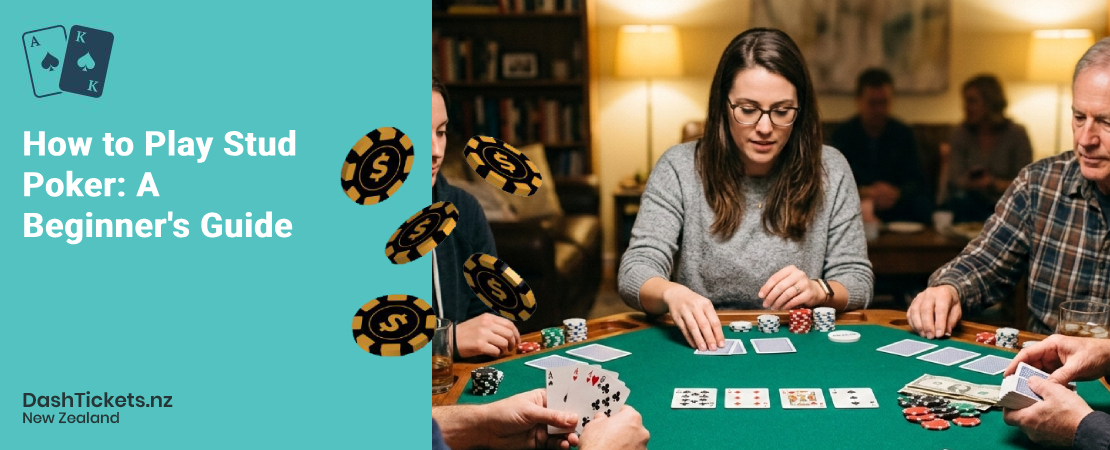
Stud poker, if you’re unfamiliar with it, is one of the older and more traditional variants of the game, and while it’s not quite as popular as Texas Hold’em, it’s definitely a game you’ll see at quite a few of the best online casinos New Zealand has to offer.
What Is Stud Poker?
Stud poker is a type of poker variant where players are dealt a combination of face-down cards – hole cards – and face-up cards – door cards. These cards are then used over multiple betting rounds, and unlike Texas Hold’em or Omaha, there are no community cards in play. Each player plays their own cards, only. Now, the most popular version of the game is Seven-Card Stud, so that’s what we’ll be focusing on here.
How to Play Seven-Card Stud Poker
Seven-Card Stud is typically played with between two and eight players, using a standard 52-card deck. There are no blinds in stud poker, and, instead, the game uses antes and a forced bet called the bring-in, which is all designed to get the action started.
A typical hand looks something like this:
Ante: Before any cards are dealt, each player posts a small ante bet which is then collected into the pot.
Third Street: The player with the lowest-ranked door card must post the bring-in, a mandatory starting bet. If two players share the same low card, the suit is used for the tiebreaker: Spades, Hearts, Diamonds, and Clubs, from low to high.
Fourth Street: A second face-up card is then dealt to each player, and the player with the highest-ranked visible card acts first. This applies on every street onwards.
Fifth Street: A third face-up card is dealt, and another round of betting takes place.
Sixth Street: A fourth face-up card is dealt, followed by another round of betting.
Seventh Street: Also known as The River, here, the final card is dealt face-down, giving each player a total of four visible cards, and three hidden ones. There’s one final round of betting, and then it’s time for the showdown.
The Showdown
Once all the betting streets have finished, the showdown happens. Here, any remaining players reveal their full seven-card hands and use the best five-card combination to determine the winner. Interestingly, standard poker hand rankings are used here – so a Royal Flush beats a Straight Flush, which beats Four of a Kind, and so on down to a High Card – quite interesting that the same rankings are used.
Then, the player with the best five-card hand wins – and takes the pot, just like in standard poker!
Betting Rounds and Limits
One thing that’s quite unique about Seven-Card Stud compared to Texas Hold’em, is that the game is almost always played with fixed-limit betting. This means bets – and raises – are capped. The betting limit tends to double from Fifth Street onwards, so if the small bet is, say, NZ$1, it then becomes NZ$2 from Fifth Street until the river.
Now, most games also cap the number of raises per round at three – sometimes four – and this means the pot can only grow so big before the action is “forced closed”.
Stud Poker Tips For Beginners
Stud Poker is a game that’s designed around patience – and observation – far more than any other variant of poker. Because so many cards are dealt face-up, paying attention to what other players are showing – and what’s already been folded – is incredibly important to making good decisions. Here’s a few things to keep in mind when you’re getting started:
Watch Dead Cards: If the cards you need to complete your hand have already been folded and are visible on the table, your odds of hitting your draw drop a lot – so this is always something that should be factored in.
Start Tight: If you’re a beginner, you should generally try to only play strong hands; ideally, three-of-a-kind, high pairs, or three cards to a flush/straight.
Attention > Position: In Texas Hold’em, “position is king” for many players. Position is still important in Stud Poker, but it’s less of a factor, because the acting order changes on each street. As a result, it’s far more important to pay attention than worry about position!
Above all, try to avoid chasing weak draws. Stud Poker is more of a grind than other types of poker games, and chasing a low flush or a gutshot straight is a quick way to go bust!
Sophia Novakivska has already been spending 12 years on everything related to gambling writing. Slot and casino reviews, comparisons, top options for different audiences, news, how-tos and gambling history - she knows the area and proved it with her publications on Better Collective, AskGamblers and Gambling.com. For four years, Sophia is into NZ iGaming niche where she analyzes the online casino bonuses, live games, new slot releases, and sport news. Sophia’s credentials: GLI University’s iGaming testing & compliance course (2020) and UKGC-approved Responsible Gambling certification (2022).
If you are one of the millions of people wondering how to win at Craps, you should know that no strategy is foolproof. You probably came across multiple advice on smart bets but what do they mean by it? How to play and not burn your bankroll? We are glad you came across this guide […]
When thinking about a popular payment method in New Zealand, I instantly remember POLi. This payment option is used by almost half of the Kiwi population, so I think POLi deserves a proper introduction to those who have never heard about it or still can’t decide whether they need it. Safe, fast, and convenient payments […]
Within the gambling gaming world at gaming casinos, you will be hearing one term more often: RTP. Quite simply, this acronym stands for Return to Player. Return to Player, or more shortly RTP, depicts the general percentage of all wagers that any particular casino game will pay out to players over time. For example, if […]

 Sophia Novakivska